Poecilosclerida, Crambeidae
|
|
|
|
|
|
| Common Name(s): | None |
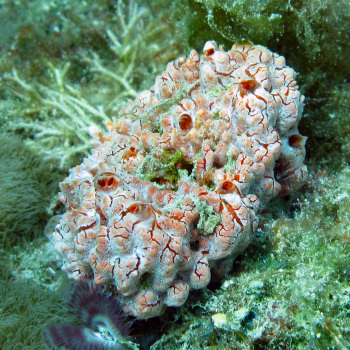
| Growth Form: | Low or tall, bushy, rounded or fan-shaped masses, sometimes with short tube-like lobes ending in oscules. |
| Surface: | Short irregular fingerlike or branched extensions, or irregular or regular ridges or lumps supported by subdermal skeletal elements. Oscules may be surrounded by converging transparent exhalant canal systems that reveal strongly contrasting interior color. |
| Color: | Red to red-orange internally with a whitish to transparent exterior membrane. Consistency: Tissue soft but skeleton tough, not easily torn. |
| Exudate: | When handled, soft tissue stains the fingers. |
| Oscules: | Elevated, 0.5-2.0 cm across. Surrounding transparent, elevated collar collapses and becomes inconspicuous when the sponge is taken out of the water. |
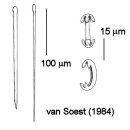
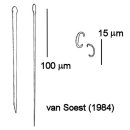
| Skeletal Components (Spicules, Fibers): | Rods with 1 abruptly pointed end and 1 round slightly swollen end (subtylostyle) in two categories: thick and slightly curved (principal), and thin and straight (secondary). Both may be long or short. Microscleres have a curved shaft and equal recurved end plates (isochela) or are C-shaped with a thin ridge on each side of the central axis (sigma). Microscleres may be absent. |
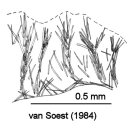
| Skeletal Architecture: | Encrusting specimens are supported at the base by plumose tracts of principal subtylostyles, followed by tracts of secondary subtylostyles, which are crowned at the surface by tufts of smaller secondary subtylostyles. Thicker, bushy, massive and fan-shaped specimens have a central meshwork of plumose spicules surrounded by spongin. |
| Ecology: | On coral reefs and hard bottoms; may encrust on dead corals, mollusk shells and gorgonian axes. |
| Distribution: | South Florida, Jamaica, Puerto Rico, Barbados, Curacao. |
| Notes: | Clathria virgultosa (Lamarck, 1814) may also form thick encrustations with surface canals forming a vein pattern. When erect, it is thinner and branching. van Soest (1984) treated this species as Monanchora barbadensis. |
| References: | Duchassaing and Michelotti (1864), Lamarck (1814-15), van Soest (1984). |