Halichondrida, Dictyonellidae
|
|
| Common Name(s): | Sven Zea’s tube sponge |
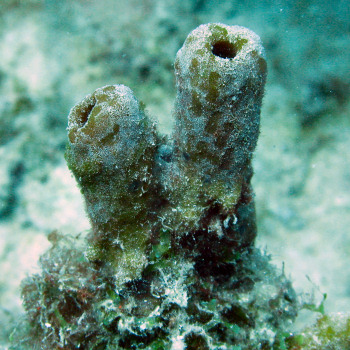
| Growth form: | Tubes of various diameters and heights arising from a common, usually buried (or crevice-filling) mass. |
| Surface: | Smooth, velvety. |
| Color: | Mustard, brownish or greenish yellow; reddish brown subsuperficially; interior cream. |
| Consistency: | Somewhat firm but crumbly. |
| Exudate: | None. |
| Oscules: | One to several, rounded to elongated, on top of tubes; no collar membrane. |
| Skeletal Components (Spicules, Fibers): | Curved, sometimes sinuous rods with 1 pointed end and 1 gently tapering rounded end (styloid). |
| Skeletal Architecture: | Ascending and interconnecting tracts of spicules cemented by spongin, forming a meshwork that radiates and ascends from the interior of the tubes towards the surface. |
| Ecology: | Usually in sandy depressions of coral reefs and hard bottoms. |
| Distribution: | South Florida, Bahamas, Cuba. |
| Notes: | Tubular specimens of Ectyoplasia ferox may resemble this species. |
| References: | Duchassaing & Michelotti (1864), Alcolado & Gotera (1986), http://www.spongeguide.org/speciesinfo.php?species=82. |