| Common Name(s): |
Lavender rope sponge |
| Growth Form: |
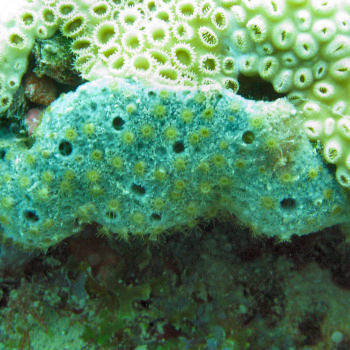
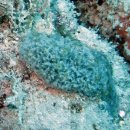
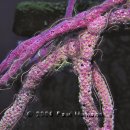
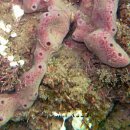
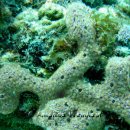
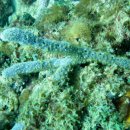
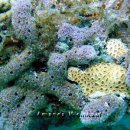
Highly variable, including erect branching, branched or unbranched runners, and massive encrusting lobes with or without branches; branches up to 2 cm across and 30 cm long. |
| Surface : |
Smooth and porous to conulose or spiky, the latter two often in patches. |
| Color: |
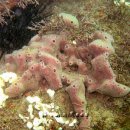
Pale purple, pink, bluish or gray externally and lighter internally. |
| Consistency: |
Compressible, tough, but easy to cut. |
| Exudate: |
None. |
| Oscules: |
Scattered irregularly, sometimes in a row on narrow branches; round and flush (2-7 mm in diameter). |
| Skeletal Components (Spicules, Fibers): |
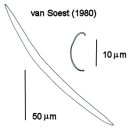
Slightly bent rods with two abruptly or stepped pointed ends (oxea), 150-230 x 3-9 μm; rods with 2 blunt round ends (strongyle) also present. Small C-shapes (sigma), which may be absent. |
| Skeletal Architecture: |
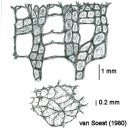
Polygonal surface meshwork of spongin fibers packed with spicules is often incomplete or poorly developed. Interior fiber meshwork arranged as irregularly radiating bundles of fibers densely packed with spicules (fibrofascicles, up to 400 μm across) accompanied by individual spicule-packed fibers, some running toward the surface and others interconnecting the fiber bundles. |
| Ecology: |
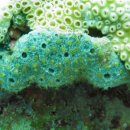
On reefs and hard bottoms. Frequently infested with the brown colonial anemone Parazoanthus parasiticus. |
| Distribution: |
Bermuda, Gulf of Mexico, South Florida, Bahamas and throughout the Caribbean. |
| Notes: |
The massive amorphous encrusting form has been treated as a separate species, Niphates amorpha Wiedenmayer (1977). However, massive specimens with erect branches arising from them (found in the Caribbean Sea) lead us to treat all growth forms as the same species. Callyspongia tenerrima Duchassaing & Michelotti (1864) grows as similar slender, more finely conulose, lavender to purple branches. |
| References: |
van Soest (1980), Zea (1987), Ruetzler et al. (2009). |
|
|
| Similar species: |
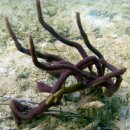
Callyspongia tenerrima |
|