| Common Name(s): |
None |
| Growth Form: |
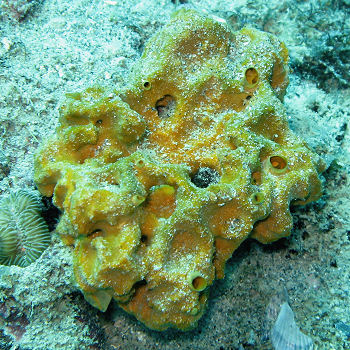
Lamellate bush similar to a cauliflower, 10-15 cm in height, with a narrow peduncle 1-3 cm in diameter; irregular rugged mass. |
| Surface: |
Irregularly corrugated. |
| Color: |
Yellow to bright orange, externally and internally. |
| Consistency: |
Rubbery and tough. |
| Exudate: |
None. |
| Oscules: |
Visible only in living specimens, with a collared membrane the same color as the surrounding tissue, 3-10 mm in diameter. |
| Skeletal Components (Spicules, Fibers): |
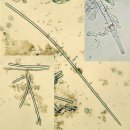
Gently curved rod with 1 pointed end and 1 blunt or rounded end (style), 250-560 X 4-10 μm, the bend usually closer to the blunt end; several with a strong bend near the blunt end. Also, some gently curved rods with 1 blunt rounded end and 1 tapered rounded end (strongyloid style), 190-350 x 10 μm. Rods with 2 pointed ends (oxea) are rare. |
| Skeletal Architecture: |
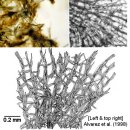
Axial plumose reticulation of spicules (main spicule tracts give off smaller tracts obliquely) bound by abundant spongin. The reticulation runs towards the surface where spicules pierce the skin. |
| Ecology: |
On patchy rocky and sandy bottoms. |
| Distribution: |
From Georgia to Florida, Gulf of Mexico, 9-61 m. |
| Notes: |
Axinella waltonsmithi resembles other Axinella species but exhibits color variations and adds oxeas to the styles. |
| References: |
Alvarez et al. (1998). |
| Similar species: |
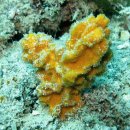
Axinella corrugata |
|