| Common names: |
None. |
| Growth Form: |
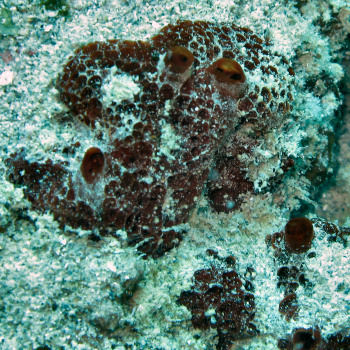
Thin to thick encrusting; 0.5-3 cm thick. |
| Surface: |
Smooth with a distinct pattern of slightly elevated warty rounded pore fields, each less than 0.5 cm across. |
| Color: |
Dark red externally and internally. May appear dark red-brown in situ. Color remains in alcohol. |
| Consistency: |
Fragile and soft. |
| Exudate: |
Dark exudate released when damaged. |
| Oscules: |
Round, irregularly distributed, elevated well above surface, about 0.5-2 cm across, with thin transparent or colored marginal membrane. |
| Skeletal Components (Spicules, Fibers): |
Two kinds of more or less straight rods: smooth with both ends pointed (oxea) (~250 x 4 μm), and spiny with one end blunt and the other pointed (acanthostyle) (~100-180 x 6 μm). Microscleres with curved shaft and symmetrical recurved end plates (isochela), ~22 μm long. Spongin only binds spicules together; no distinct fibers. |
| Skeletal Architecture: |
Exterior skeleton consists of abundant spicules at the surface supporting the rounded warts. In the interior, large rods are concentrated in bundles rising up from the substrate and branching outward but not interconnected (dendritic). |
| Ecology: |
Common on reefs, encrusting dead corals or the bases of live corals or on metamorphic rocks. |
| Distribution: |
South Florida and throughout the Caribbean to at least 35 m. |
| Notes: |
The surface pattern (‘areolated pore fields’) of this species is striking and diagnostic. Batzella rubra has a similar habit and is also red, but somewhat lighter. It lacks the rounded surface warts and has no spined megascleres. |
| References: |
de Laubenfels (1936, as Merriamium tortuganense), van Soest (1984), Zea (1987). |
| Similar species: |
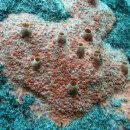
Cliona delitrix |
|