Hadromerida, Placospongiidae
|
|
|
|
| Common name(s): | Armored sponge |
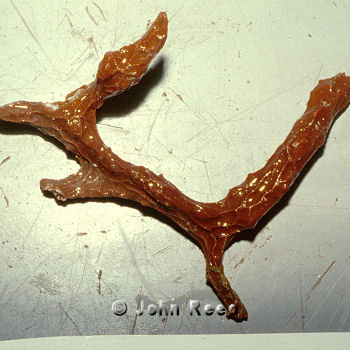
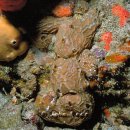
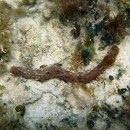
| Growth Form: | Thick encrusting, or recumbent runners or branches. |
| Surface: | Non-porous, with grooves, grooved ridges, or split by shallow grooves into irregularly polygonal plates. The grooves contract and become narrow ridges out of the water. |
| Color: | Tan, brown or orange-brown; grooves gray or whitish. Interior white. |
| Consistency: | Stony hard. |
| Oscules: | Flush, scattered along grooves, with a white collar membrane. Multiple canal openings are visible within each oscule. |
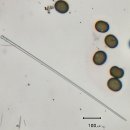
| Skeletal Components (Spicules, Fibers): | Several different spicule forms: 1) straight or slightly sinuous long rods with 1 pointed end and 1 round swollen end (tylostyle), 560-990 x 6-12 μm; 2) spherical, oval, kidney- or 8-shaped, covered with star-shaped holes (actually the tips of fused rays) (selenaster, sterraster), 44-50 x 28-34 μm, and 3) small stars with short rays (spheraster), 9-19 μm across. |
| Skeletal architecture: | A thick cemented surface layer of sterrasters/selenasters is often divided into separate armor-like plates. Thick bundles of tylostyles radiate or ascend toward the surface from an interior axis of densely packed sterrasters/selenasters. |
| Ecology: | On shallow inshore hard bottoms often associated with seagrasses; recorded from Brazil in 25 m. |
| Distribution: | South Florida; Recife, Brazil. |
| Notes: | The small spherasters and the absence of spirasters distinguish this from other Placospongia species. |
| References: | Boury-Esnault (1973). |