| Common name(s): |
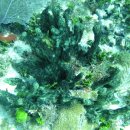
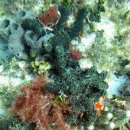
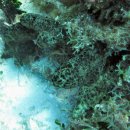
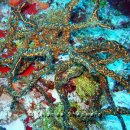
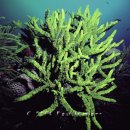
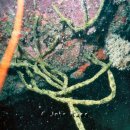
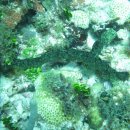
Green finger sponge; black rope sponge |
| Growth Form: |
Tangles of rope-like branches, sprawling branches or branching bushes; smaller specimens sometimes as lobes, runners, massive or encrusting. |
| Surface: |
Chiefly covered with conules, which become more obvious when the sponge is touched and sharp when dry. This species may also appear rough or smooth for some or most of surface, and small specimens may be mostly or entirely smooth. |
| Color: |
Black, usually mottled with light green; sometimes all greenish-yellow. |
| Consistency: |
Tough, resilient; barely compressible. |
| Exudate: |
Dark purplish exudate when squeezed. |
| Oscules: |
Small (2-6 mm across), scattered or in a row along branches; flush or slightly raised on small lobes, and surrounded by a thin collar the same color as the surrounding tissue. |
| Skeletal Components (Spicules, Fibers): |
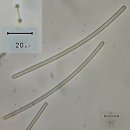
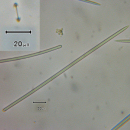
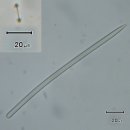
Two types of megascleres, both ranging from long and thin to short and fat, and both either straight or slightly bent: rods with 2 blunt round ends (strongyle) (140-230 x 3-5 μm) and rods with 1 abruptly pointed end and 1 blunt or rounded end (style) (140-240 x 3-6 μm). Microscleres are tiny double umbrellas (birotula) (10-15 μm long). |
| Skeletal Architecture: |
Exterior skeleton a deeply pigmented organic crust with scattered spicules. Inner skeleton consists of thick spicule tracts 35-100 μm in diameter arranged in a rectangular meshwork (100-700 μm across) and cemented by variable amounts of spongin. |
| Ecology: |
Found in mangroves, lagoons, on hard substrates and reefs to a depth of 90 m. Often hosts the yellow or orange colonial anemone Parazoanthus swiftii (Zoanthidea). |
| Distribution: |
South Florida, Bahamas, Caribbean. |
| Notes: |
Iotrochota arenosa is a black encrusting species that incorporates sand and rubble. |
| References: |
van Soest (1984, 2002 [in Hooper & van Soest 2002]), Zea (1987). |
| Similar species: |
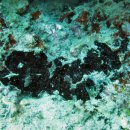
Iotrochota arenosa |
|