| Common Name(s): |
None. |
| Growth Form: |
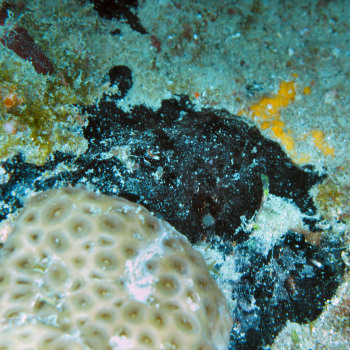
Thick encrustations that agglutinate sand and rubble, and appear partly buried. |
| Surface: |
Dirty with sediment; appears smooth when dermis is stretched, but feels rugged when handled. |
| Color: |
Dark purple; may be black in situ. |
| Consistency: |
Surface soft, fibers tough. |
| Exudate: |
Abundant purple mucus that stains the hands. |
| Oscules: |
Not apparent. |
| Skeletal Components (Spicules, Fibers): |
Two types of megascleres: bent rods with 1 abruptly pointed end and 1 blunt or rounded end (style) in a wide range of sizes; straight or bent rods with 2 blunt round ends (strongyle). The straight strongyles are longer; the bent strongyles are not as large as the larger styles. Microscleres are tiny double umbrellas (birotula). |
| Skeletal Architecture: |
A loose network formed by bundles of spicules embedded in spongin and incorporating abundant sediment. |
| Ecology: |
In sand and rubble on coral reefs, in lagoons, and on mangroves and artificial substrates (pilings). |
| Distribution: |
South Florida, Jamaica, Puerto Rico, Belize in 0.1-45 m. |
| Notes: |
Iotrochota birotulata is usually at least partly greenish and typically grows as branches, bushes, runners or lobes, though it may encrust. Neopetrosia carbonaria is also black, encrusting, usually covered with sediment, and releases a dark exudate, but is more massive, and has oscules on stiff tubular projections. |
| References: |
Higgin (1875), Ruetzler et al. (2007). |
| Similar species: |
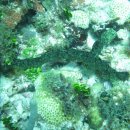
Iotrochota birotulata |
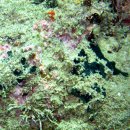
Neopetrosia carbonaria |
|