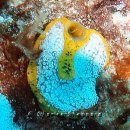
| Common Name(s): |
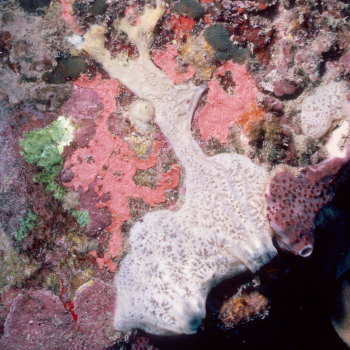
Orange icing sponge, Orange undercoat sponge |
| Growth Form: |
Thinly to thickly encrusting. |
| Surface: |
Smooth, porous, covered by a transparent membrane. Distinct canals converging on oscules are visible when the boulder or coral under which it lives is overturned. |
| Color: |
Orange to yellow, with canals and oscular membrane whitish to transparent. Specimens in dark habitats may be white. |
| Consistency: |
Fragile, easily torn, although spicule tracts may be slightly tough. |
| Exudate: |
None. |
| Oscules: |
Round, elevated by a tall, transparent collar membrane with fine parallel lines; found along the outer edge of the surface accessible to the sponge; often wider than the surrounding tissue. |
| Skeletal Components (Spicules, Fibers): |
Megascleres are slightly bent rods with 1 abruptly pointed end and 1 blunt or rounded end (style). Microscleres include 1) large and small curved shafts with unequal recurved end plates (anisochela), the large ones often arranged in bouquets or rosettes; 2) large and small C- or S-shapes (sigma), and 3) bundles of hair-like spicules (raphides in trichodragma) abundantly scattered in the tissue. |
| Skeletal Architecture: |
Incomplete, confused surface meshwork of single megascleres with microscleres scattered between. Interior dominated by ascending, interconnecting, rather irregular thick tracts of megascleres (40-310 μm across) ending in spicule brushes that protrude at the surface. |
| Ecology: |
Under and lining the edges of plate-like or overhanging stony coral colonies, calcareous worm tubes or boulders on coral reefs and hard bottoms; sometimes modifying the pattern of coral colony growth. |
| Distribution: |
South Florida, Bahamas and throughout the Caribbean. |
| Notes: |
Halichondria cf. magniconulosa also forms cryptic encrustations, but does not characteristically protrude along the edges of corals or rock substrates. |
| References: |
Carter (1882), van Soest (1984), Zea (1987). |
|
|
| Similar species: |
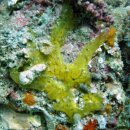
Halichondria cf. magniconulosa |
|