| Common Name(s): |
None. |
| Growth Form: |
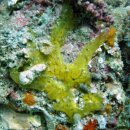
Thin to thick crust (< 1 cm thick). |
| Surface: |
Smooth, with a few dermal canals that run towards the oscules. |
| Color: |
Yellow externally and internally |
| Consistency: |
Fragile, easily torn. |
| Oscules: |
Few visible, <5 mm in diameter. |
| Skeletal Components (Spicules, Fibers): |
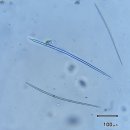
Rods with 2 pointed ends (oxeas) in a wide size range, 380-600 x 6-7 μm. |
| Skeletal Architecture: |
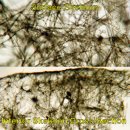
Tracts of spicules run tangentially to the surface. Interiorly, loose spicule tracts run in various directions with spicules strewn among them. |
| Ecology: |
Found under rocks in South Florida. Chiefly on mangrove roots in the Caribbean. |
| Distribution: |
South Florida and throughout the Caribbean in shallow water, with one report from 177 m from the Bahamas (Diaz et al., 1993). |
| Notes: |
This is probably a young specimen of H. magniconulosa. The encrusting form and smooth surface may be associated with its location under a rock. H. magniconulosa is normally more massive with an irregular, rugose surface, and usually has pink to green tinges mixed with the yellow tissue. Otherwise, this specimen approaches H. magniconulosa more closely than other described species of Halichondria. The notation “cf.” indicates that the identity has not been confirmed. |
| Reference(s): |
Diaz et al. (1993). |
| Similar species: |
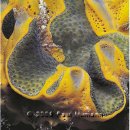
Mycale laevis |
|